Guides
The Korean Trader Funnel: The Money Goes In at the Top, the Leaks Are at the Bottom
Talk to teams preparing for Korea and a lot of conversations end on the same request.
"Can you introduce us to some Korean traders?"
It's an understandable ask. Traders bring volume, and once there's volume, the thinking goes, everything else follows.
But in our experience, introductions are not where things get stuck.
Connecting a team with traders isn't hard. Getting those traders to try the product once is easier than most teams expect.
The trouble starts after that.
So we ask a different question.
Where do the traders you've been introduced to stop?
Few teams can answer on the spot. Some know signups but not deposits. Others know volume but not how many people it actually came from.
How people think about trader acquisition
Many teams treat trader acquisition as a reach problem.
Tell more people, get more people. So the budget piles up almost entirely at the top. KOL posts, AMAs, Telegram room promotions, airdrop campaigns.
Performance gets measured at the top too. Impressions, views, room members.
Those numbers almost always look good. They are the numbers that react fastest to money.
Spend at the top, grade at the top. What happens further down rarely makes it into the report.
The funnel we actually see
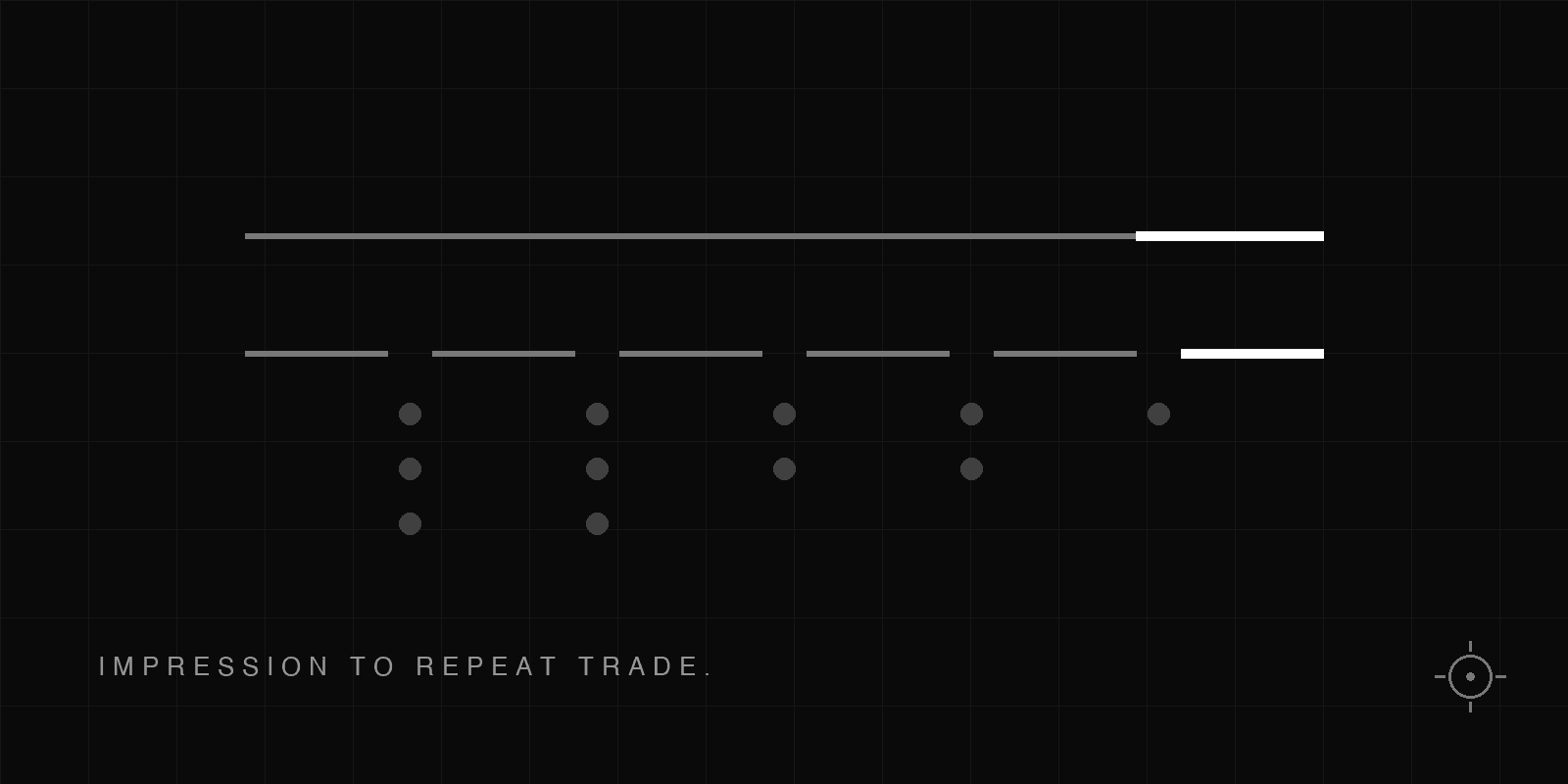
Between first seeing a new product and sticking with it, a Korean trader passes through roughly six stages.
Exposure, interest, evaluation, deposit, first trade, repeat trade.
Each stage loses people for a different reason.
Exposure to interest. Korean traders have seen products like yours many times. Another Perp DEX launching is not enough to catch their eye. If they can't see in one line how it differs from what they already use, they scroll past.
Interest to evaluation. A curious trader doesn't go back to the ad. They dig through the Telegram rooms they're in, search Naver, and look up what the traders they trust have said. If there's no trace of anyone actually using it, they won't even open the product.
Evaluation to deposit. From here on, every drop-off gets expensive. A trader opens the interface and makes up their mind within minutes. Is the order book deep? What do the spreads look like? Can the fee structure be read at a glance? Whether the Korean reads awkwardly gets judged in the same pass.
Even if the screen looks right, the deposit is a separate problem. A deposit is not interest. It's a decision. Most Korean traders keep their funds on domestic exchanges. They withdraw from there, route through a wallet, switch chains if needed, and only then deposit. Every step is a reason to stop. And a deposit put off once often never happens.
Deposit to first trade. A surprising number of accounts deposit and never trade. Liquidity on the pair they want is thin. They place an order and slippage is bigger than expected. Margin and leverage settings work differently from where they used to trade. While they hesitate, the balance just sits there.
When the first trade does come, it's usually small. Traders check execution with a small amount first. Many teams count that first trade as a conversion. To the trader, it's still a test.
First trade to repeat trade. This is where the funnel leaks most.
The first trade runs on expectation. The second runs on experience.
Before the first trade, what a trader is buying into is a promise. Reward terms, points explainers, whatever a KOL said. After it, the yardstick changes. They start comparing execution speed, spreads, and fees against the exchange they use every day.
If anything falls short, they quietly go back to where they came from. They don't announce that they're leaving.
Incentives cover up this hole. While airdrop points and referral rewards keep flowing, repeat trading looks perfectly healthy.
Incentives also decide who shows up. Design for people who respond to the size of the reward, and you attract people who respond to the size of the reward. Those traders leave the day the rewards end. They didn't change their minds. They did exactly what they came for.
Getting someone to try a product isn't hard. Getting them to come back is.
The expensive leaks are at the bottom
The same drop-off costs very different amounts depending on where it happens.
A trader who scrolls past in a feed cost you almost nothing.
A trader who reaches the deposit screen is different. That one person already carries the cost of the KOLs, the content, and the community management. When they leave right before depositing, or right before their first order, everything spent above them disappears at once.
Yet most teams move in the opposite direction. When results don't show up, they spend more at the top. Buy more exposure, add more KOLs. With the bottom leak still open, that money just produces more traders who stall in front of the deposit.
Fix the bottom and the story changes. Remove one step from the deposit path, and every trader who arrives after that takes the shorter route. When a campaign ends, the exposure is gone. The fixed funnel stays.
Trader introductions run through the same funnel. An introduction is a shortcut into the middle of it. But introduced traders make the same call at the deposit and at the first order. Because they arrived with expectations, they often make it faster.
That's why introductions are more expensive than they look. Connect good traders to a product that isn't ready, and you lose not just those traders but the rooms they sit in.
It's also why, when someone asks us for introductions, we look at the funnel before the list. We measure performance on deposits and trading, not exposure. And we watch how much shrinks between each stage. The stage with the steepest drop is where the next budget should go.
So this is what we check
Before designing trader acquisition, there are questions we always ask.
- From exposure to repeat trade, do you know how many people are left at each stage?
- Have you walked the path yourself, from a domestic Korean exchange account all the way to a deposit?
- Are you tracking accounts that deposited but never made a first trade?
- Are spreads and execution on your main pairs better than where Korean traders already trade?
- The week after rewards end, are traders still coming back to trade?
If two or more of these have no answer, we don't think it's time to bring in more traders.
The point
Meeting Korean traders is not the hard part.
The hard part is the deposit button, and what comes after the first trade.
Teams that watch only the top buy numbers. Teams that watch the bottom win traders.
If you're preparing to acquire Korean traders, look at your current funnel before any list of introductions: where traders stop, and whether the product, the deposit path, or the incentive design is the reason. Kairos Atlas Trader Acquisition measures results in signups, KYC, deposits, active traders, volume, and revenue rather than exposure, and works with you to close the most expensive leaks first.